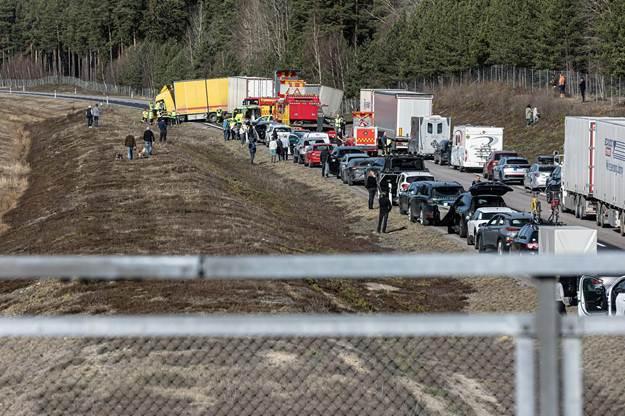
Phoenix sits at the intersection of some of the busiest commercial trucking corridors in the Southwest. The I-10 runs east to west through the heart of the metro, connecting Los Angeles to Texas. The I-17 runs north to south, linking Phoenix to Flagstaff and the distribution hubs beyond. Both carry heavy commercial traffic every hour of every day, and both see serious truck accidents with regularity.
When a loaded semi is involved in a collision, the outcome for the other vehicle is rarely minor. Understanding what happens in the aftermath, from the scene to the claim, can make a significant difference in how the situation resolves.
The Numbers Behind the Risk
Arizona recorded 2,750 crashes involving large trucks and buses in 2024, according to the Federal Motor Carrier Safety Administration. Those crashes resulted in 144 deaths and 1,090 injuries statewide. The year prior saw 2,775 large-truck crashes with 134 fatalities. The numbers have held stubbornly consistent over several years, with Maricopa County, home to Phoenix, accounting for the largest share by a significant margin.
Truck accidents are a different category of crash than passenger vehicle collisions. A fully loaded semi can weigh up to 80,000 pounds. The stopping distance at highway speed is measured in football fields, not car lengths. When something goes wrong, the physics are unforgiving, and the injuries sustained by occupants of smaller vehicles reflect that. Anyone dealing with the aftermath of a serious collision should speak with a truck accident lawyer serving the Phoenix area before talking to any insurance adjuster, because these cases move quickly and the stakes are high.
Why Truck Accident Cases Are More Complex Than Car Accident Claims
The instinct after any collision is to treat it like a standard insurance claim. With truck accidents, that instinct works against you. The complexity is real, and it starts with the question of who is actually liable.
In a car accident, fault typically comes down to two drivers. In a truck accident, the potentially liable parties can include:
The truck driver, for errors including fatigue, distraction, speeding, improper lane changes, or following too closely
The trucking company, for negligent hiring, inadequate training, pressuring drivers to exceed hours-of-service limits, or failing to maintain the fleet
The cargo loader or shipper, if improperly loaded or secured freight shifted and caused the driver to lose control
The truck manufacturer or parts supplier, if a mechanical failure, such as brake failure or tire blowout, contributed to the crash
A maintenance contractor, if a third-party service provider failed to identify or repair a known defect
Identifying all liable parties matters because it determines which insurance policies apply and what the total available coverage looks like. Commercial trucking policies carry much higher limits than personal auto policies, but they are also defended aggressively by carriers who have dedicated legal teams and adjusters experienced in minimizing payouts.
Federal Regulations That Shape Liability
Commercial trucking operates under a federal regulatory framework that does not apply to passenger vehicles. The Federal Motor Carrier Safety Administration sets rules covering how long drivers can be on the road, how vehicles must be maintained, how cargo must be secured, and what training and licensing commercial drivers must hold. When an accident occurs, violations of those regulations are often central to the liability analysis.
Hours-of-service rules are among the most frequently cited. Federal regulations limit how many consecutive hours a commercial driver can operate without a mandatory rest break, and how many total hours can be logged in a given period. Trucking companies facing tight delivery schedules have financial incentives to push drivers close to those limits, and drivers facing pressure to perform have incentives to underreport their actual hours. When fatigue is a factor in a crash, the electronic logging device data from the truck becomes critical evidence.
Maintenance logs, inspection records, and driver qualification files are all subject to federal retention requirements. One of the first priorities after a serious truck accident is preserving that documentation before it is altered, lost, or destroyed. Trucking companies are not obligated to hold records indefinitely, and the standard retention periods are short relative to how long litigation can take.
What to Do at the Scene
The scene of a truck accident is often chaotic. Vehicles may be blocking multiple lanes. Injuries can be severe. The truck driver, if uninjured, may be in contact with their dispatcher and the company’s insurance carrier within minutes of the crash. Here is what matters most in those first moments:
Call 911 immediately. A police report is essential. Do not move vehicles unless required to do so for safety reasons, and make sure responding officers document the full scene.
Document everything you can. Photograph all vehicles from multiple angles, the truck’s DOT number and company markings, license plates, cargo condition, skid marks, road conditions, and any visible injuries. If there is a dashcam in your vehicle, preserve that footage before it overwrites.
Get witness contact information. Other drivers who saw the collision are often the most credible independent witnesses available.
Do not discuss fault at the scene. This applies to conversations with the truck driver, their company representative, if one arrives, and certainly to any recorded statement requests from insurance personnel.
Seek medical attention the same day. Even if you feel functional, get evaluated. Adrenaline masks pain, and injuries to the neck, back, and head often worsen over the following 24 to 72 hours.
Common Injuries and Why They Take Time to Understand
The injuries sustained in truck accidents tend to be more severe than those in passenger vehicle crashes, for the simple reason that the force involved is far greater. Spinal injuries, traumatic brain injuries, internal organ damage, and multiple fractures are common outcomes when a smaller vehicle is struck by a loaded commercial truck.
What complicates the medical picture is that the full extent of these injuries is often not apparent immediately. A concussion may not be diagnosed at the emergency room. Herniated discs may not show up clearly on initial imaging. Soft tissue injuries that will require months of treatment are dismissed in the first 24 hours as soreness. This is why accepting any settlement or signing any release before completing treatment, or at a minimum before understanding the full scope of what treatment will require, is a serious mistake. Once a release is signed, the claim is closed regardless of what surfaces later.
How Fault Is Assigned Under Arizona Law
Arizona follows a pure comparative fault system. In a truck accident, fault can be divided among multiple parties in any proportion, and each party’s liability is reduced to match their percentage of fault. A victim found 10% at fault for, say, following too closely before the impact, can still recover 90% of their total damages.
What this means in practice is that trucking companies and their insurers will investigate the accident with the specific goal of finding any basis to assign fault to the other driver. That investigation begins immediately after the crash. The company’s insurer is typically notified before the truck driver leaves the scene. By the time an injured person is discharged from the hospital and thinking about their claim, the defense team has often already been working the case for days.
That imbalance is the core reason why the timing of legal representation matters in truck accident cases. The preservation of electronic logging data, black box information, maintenance records, and surveillance footage from nearby businesses is time-sensitive. Waiting weeks to seek advice is waiting weeks for evidence to disappear.
The Insurance Reality
Commercial trucking policies carry substantially higher liability limits than personal auto insurance. Federal law requires interstate carriers to maintain a minimum of $750,000 in liability coverage, and many large carriers carry policies well above that floor. That coverage exists because the damages in serious truck accidents are real and substantial, but it also means the insurer has a significant financial incentive to minimize the payout.
The first settlement offer in a truck accident case is rarely close to what the claim is worth. Adjusters are trained to move quickly, make early contact with injured parties, and settle before the full picture of medical costs, lost income, and long-term impact becomes clear. The size of the policy on the other side is not a reason to move slowly on your own claim. It is a reason to make sure you understand what the claim is actually worth before agreeing to anything.