When modifying a vehicle for track use, off-roading, or daily safety, the placement of safety equipment is often an afterthought. However, in the event of a collision or sudden fire, the accessibility of your fire extinguisher is the single most critical factor in preventing a total loss. Incorrect placement does not just delay reaction time—it can turn the heavy steel cylinder into a lethal projectile inside the cabin. To ensure safety and compliance with motorsport regulations, drivers must prioritize accessibility, security, and the preservation of vehicle integrity.
The Ideal Mounting Location
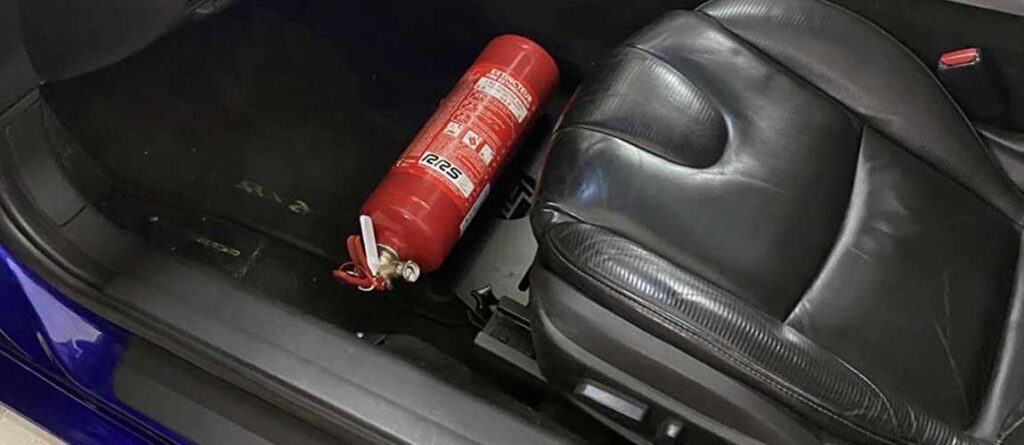
The best place to mount a fire extinguisher in a car is directly below the front driver or passenger seat. This location utilizes dead space in the cabin, prevents the cylinder from becoming a dangerous projectile during a crash, and ensures the driver has immediate, tool-free access in an emergency. Unlike trunk storage, which is inaccessible during a fire, or A-pillar mounts, which can obstruct vision, an under-seat mount keeps the center of gravity low and the device within arm’s reach. However, standard plastic clips often fail under heavy braking or track conditions. To meet safety standards, the extinguisher must be secured using a steel fire extinguisher bracket. Manufacturers like F4 Fabrications engineer these specific mounts to bolt directly into the factory seat rails, ensuring the cylinder remains perfectly restrained under extreme deceleration without requiring custom drilling.
Why “Within Arm’s Reach” Matters
A vehicle fire can double in intensity every few seconds. If a driver has to exit the vehicle, open the trunk, and rummage through luggage to find an extinguisher, the fire may have already breached the fuel lines or firewall.
- Reaction Time: Mounting the unit in front of the seat allows the driver to grab the release handle instantly, even if the door is jammed or the seatbelt is locked.
- Track Compliance: Most racing organizations (such as the SCCA or NASA) require the extinguisher to be reachable by the driver while strapped in.
- Visibility: A mount that is out of sight is often out of mind. Seeing the pin and gauge every time you enter the car serves as a passive safety check.
The Engineering Behind the Mount
Not all brackets are created equal. The forces generated during a crash can exceed 20 Gs. A 2.5lb extinguisher effectively becomes a 50lb sledgehammer flying through the interior. This is why generic “universal” mounts often fail. They rely on friction or cheap straps that stretch upon impact. A dedicated engineering approach is required. By utilizing the seat rail bolts—which are already tested to withstand massive loads—a specialized steel bracket becomes an integral part of the chassis. This method avoids the need to drill into the floorpan, which can introduce rust points or damage underlying wiring harnesses.
Final Thoughts: Security is Not Optional
The decision of where to mount your fire extinguisher is not about aesthetics; it is about physics and survival. By securing the device to the seat rails, you are leveraging the strongest part of the interior to protect yourself. Do not wait for an emergency to discover that your safety gear is out of reach or insecurely mounted. Verify your setup today.